
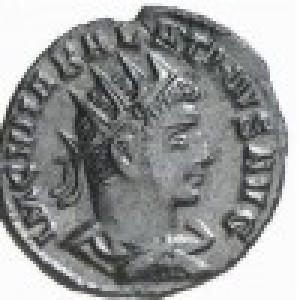
His father was Septimius Odaenathus, King of Palmyra, and his mother was Queen Zenobia. When his father was assassinated by his cousin Maeonius (267), the young Vabalathus was made king (rex consul imperator dux Romanorum, "illustrious King of Kings" and corrector totius orientis) of the Palmyrene Empire. Effective power was wielded by his mother Zenobia, who conquered Egypt, Syria, Palestine, Anatolia and Lebanon.
Initially the Roman Emperor Aurelian recognized Vabalathus' rule, perhaps because he was engaged in conflict with the Gallic Empire in the west and hesitated to incite open warfare with the Palmyrene Empire. This mutual recognition is testified by early coins minted under Vaballathus, in which Aurelian is portraited with the title augustus; however, the relationship between the two empires deteriorated and Aurelian disappeared from his coins, while Zenobia and Vabalathus and adopted the titles of Augusta and Augustus respectively.
The end of Vabalathus' rule came when Aurelian conquered and sacked Palmyra (272/3) and took Vabalathus and his mother back to Rome as hostages. According to Zosimus, Vaballathus died on the way to Rome, but this theory has been neither confirmed nor disproved.
Other sources have implied that after shipping the defeated Zenobia and Vabalathus back to Rome, Aurelian allowed both of the rebels to live, but only after they had been marched through the streets of the imperial city in accordance with Roman tradition. This would have been humiliating, but better than death. This theory is supported by Aurelian's similar treatment of the Tetricii (Tetricus I and Tetricus II) in Gaul, also allowing long time enemies of Rome to retire following their defeat at the Battle of Châlons (274) in 274.


