
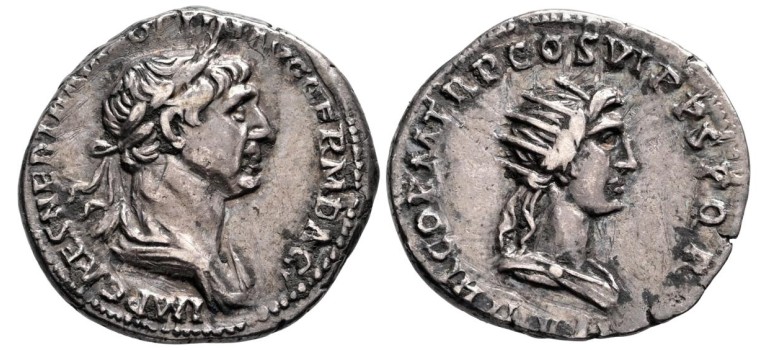
Trajan, 98-117. Denarius (Silver, 19 mm, 3.33 g, 8 h), Rome, circa autumn 116-August 117. IMP CAES NER TRAIAN OPTIM AVG GERM DAC Laureate and draped bust of Trajan to right, seen from behind. Rev. PARTHICO P M TR P COS VI P P S P Q R Radiate and draped bust of Sol to right. BMC 624. Cohen 189 var. (differing bust). RIC 329 var. (differing bust). Woytek 573v. Nicely toned. very fine.
Although the Romans probably revered the sun from the earliest times, the official cult of the sun god Sol Indiges initially remained relatively minor. Roman tradition attributed its introduction to Titus Tatius. Sol had an ancient sanctuary near the River Numicius, as well as a temple in the Circus Maximus and a shrine on the Quirinal Hill, where an annual sacrifice was offered on 9 August. The Romans were therefore familiar with a solar deity, but Sol appeared only infrequently on early Roman coinage. An eastern revival of the cult was needed to bring him greater prominence. By AD 158, the cult of Sol Invictus was established in Rome, as shown by a military votive inscription. Rome’s contact with the Syrian solar cult may have begun under Hadrian, whose close ties with the eastern provinces intensified after he served as legate of Syria. Sol first appeared more prominently on Trajan’s coinage as a deliberate reference to his eastern conquests. The god also featured early in Hadrian’s reign, explicitly personifying the East through the inscription ORIENS. This imagery both continued Trajan’s eastern legacy and reflected Hadrian’s own strong connections with that part of the empire.