
- Stock: Sold
- Model: Lupa romana sestertius
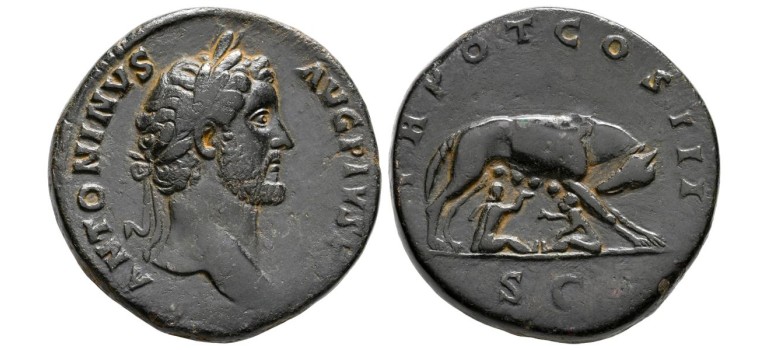
Antoninus Pius, 138-161. Sestertius (Orichalcum, 33 mm, 25.21 g, 2 h), Rome, circa 140. ANTONINVS AVG PIVS P P Laureate head of Antoninus Pius to right. Rev. TR POT COS III / S C She-wolf standing right, head turned back to left, suckling the twins Romulus and Remus. BMC 1320. Cohen 917. RIC 648. A rare variety with she-wolf looking back to left. Somewhat smoothed, otherwise, very fine.
The reverse scene depicts the myth of Rome's legendary founders, the twin brothers Romulus and Remus, being nurtured by a she-wolf. Some examples of the type show the wolf in a cave, which was located on the Palatine Hill in Rome. The cave was the center of the festival of the Lupercalia, a fertility rite in which young Roman men ran naked around the Palatine, hidden with only a wolf's skin draped over their heads, using short leather thongs to lightly whip any women they encountered. The race must have been great fun for young Romans and was said to date back to Romulus' and Remus' youth, when they began the custom as an act of youthful mischievousness. In 2007 archaeologists working on the restoration of Augustus's palace on the Palatine discovered a cave that they believe to be the Lupercalia cave. It was found 16 meters (52 feet) below ground, and has at its center a white eagle. The walls and ceiling are decorated with seashells, colored marble mosaics and pumice stones, and the remains are said to be very well preserved.