
- Stock: In Stock
- Model: Phraates IV tetradrachm Parthians
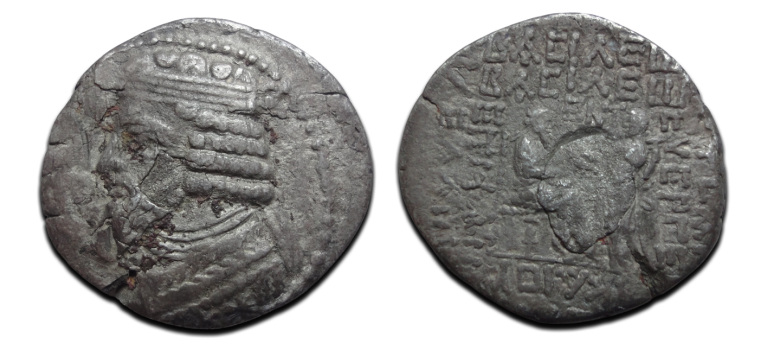
Kingdom of Parthia. Phraates IV. Tetradrachm. Gorpiaios SE 288 = August 24 BC. Seleukeia on the Tigris. (Sellwood-52.6). Anv.: Diademed bust to left, with wart on forehead. Rev.: ΒΑCΙΛΕΩΣ ΒΑCΙΛΕΩΝ ΑΡΣΑΚΟY EYEPΓETOY ΔΙΚΑΙΟY ΕΠΙΦΑΝΟYΣ ΦΙΛΕΛΛΗΝΟΣ, Phraates seated to left, receiving wreath from Tyche, standing right; ΗΠΣ ΓΟΡΠΙΑΙ (date in exergue). Ag. 9,73 g. Good fine, Flan cracks
Phraates IV was the second heir to Orodes II, named to succeed his father in the wake of his brother Pakoros’ death. After murdering his father, Phraates purged his brothers and their families. A Parthian noble also under threat from Phraates fled to the west, and in 36 BC successfully appealed to Mark Antony to back him as a rival claimant. Antony led a force of 100,000 men into Parthia, but his overconfident leadership resulted in defeat and the loss of 35,000 men. A few years later, Phraates was embroiled in a civil war with a usurper named Tiridates. Initially forced to flee Parthia, Phraates regrouped his forces and re-invaded. Tiridates was forced to seek safety among the Romans, but managed to take with him a favorite son of Phraates. The Romans refused to return this son unless the standards captured from Crassus’ debacle at Carrhae were exchanged for him. Initially rebuked, the Romans, now under Augustus, began preparations (or the appearance of such) for a massive Parthian campaign. Finally, in 20 BC, Phraates agreed, and the exchange was made (an event prominently featured in the coinage of Augustus). Also included in the exchange was the presentation to Phraates of a slave girl named Musa, who was accompanied by her own son, Phraatakes. In time this concubine became Phraates’ queen. In 10 BC, she persuaded the king to send his own sons to Rome for their “safety”. Cleared of any rivals to her son, she poisoned Phraates in 2 BC, and promoted Phraatakes as his successor.