
Roman coins for beginners.
What if you landed on my site and have just a little knowledge about Roman coins? Where could you learn more about them? Terms like: denomination, mint and exergue can be a bit daunting at first.
This blog is a good place to start. First, I offer you a short explanation of the denomination of the Roman coins. They are listed in order of decreasing value. After that there is a short explanation of the abbreviations of metals that the coins are made of, and last but not least follows a short explanation on grading, place of mintage and a short oversight of abbreviations which help recognize legenda.
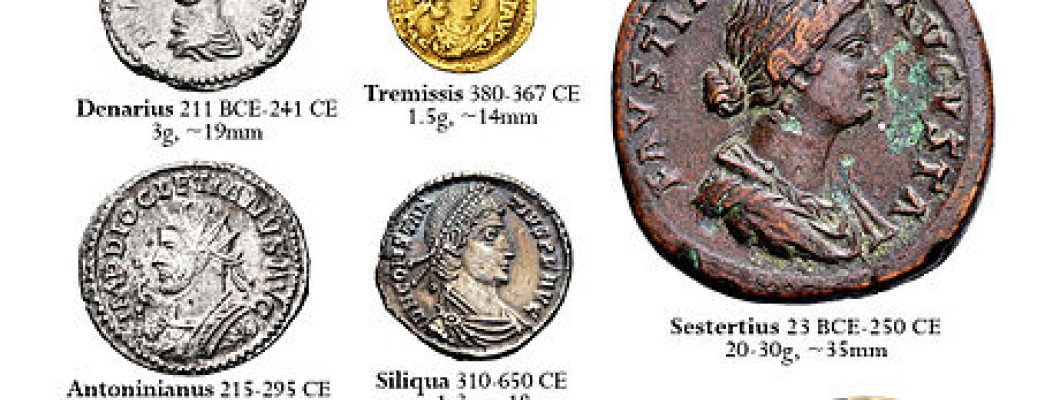
a. The Solidus is made of 24 carat gold. It weighs about 4.5 grams and was brought in circulation by Constantine the Great around 310 BC. In earlier times it was called an Aureus, which with its’ 8 grams was notably heavier.
b. The Denarius is made of silver. It weighed around 4.5 grams during the time of Commodus but dwindled down to a meager 3 grams until it was abolished during Diocletian’s reign. At first it had a value of 25 against one Aureus. But around 350AD it had a value of 3.6 million against one Solidus.
c. The Antoninian is also made of silver. It is the successor of the Denarius. Caracalla brought it into circulation in 215AD. At first it was a silver coin with an intended value of 2 Denarii but the coins’ silver content was actually lower and grew less with time. At one point it was plated in silver and was required to have a minimal content of silver, because of this it is also called a silvered Antonianus. It was abolished under Emperor Diocletian. The coin is easily recognizable because an Emperor wears a radiate crown on his head and an Empress’ shoulders are adorned with crescents.
d. The Sestertius is made of bronze. With its average diameter of 30 mm (in the 1st century even 35 mm) and weight of 25 grams it is the biggest of the Roman coins. If it has a lovely green patina it is especially sought after. A Sestertius has a value of 4 Asses or 2 Dupondi or a ¼ denarius. After 275 (with Aurelius as Emperor) the coin was abolished. A soldier earned 18 Sestertii a month.
e. The Dupondius is made of brass. It has a diameter of 27 mm and weighs 15 grams. Its’ value is ½ a Sestertius or 2 Asses. It is usually recognizable by its’ radiate crown on the Emperor or crescents on the shoulders of the Empress. These symbols don’t occur on the As coins. A Dupondius is smaller and lighter than a Sestertius and Asses are made of copper. It disappeared under the reign of Emperor Diocletian.
f. An As is made of copper, and has a diameter of 27 mm and weighs about 9-12 grams. Its value was ¼ Sestertius. It can be differentiated from the Dupondius because its’ lack of radiate crown or crescents. The As was abolished under Emperor Diocletian.
g. The Semis is made of brass, and has a diameter of 20mm and weighs about 3-6 grams. Its’ value was ½ an As.
h. The Quadrans is made of copper. It has a diameter of 17 mm and weighs about 3 grams. It’s value was a ¼ As, hence its’ name.
i. The Follis is made of copper. These coins were initially covered in a thin layer of silver, which mostly have disappeared over time, on some coins this silver layer will still be discernable! Originally the Follis was valued at 12.5 Denarii, later it was valued at 25 Denarii. In 346 the coin was abolished.
j. Maiorina or AE1, is made of bronze and was initially covered in a silver layer. It has a diameter of 26-30 mm. It is the successor of the Follis. Emperor Constantine introduced it. It was valued at ½ Siliqua. The Maiorina was bigger than the Follis and had sparse silver content.
k. The Centenionalis or AE2 is made of bronze and has a diameter of 22-26mm, later emissions shrunk to 18-22mm.
l. The Half-Centenionalis or Nummus (the earlier emissions) or AE3, is made of bronze and was also initially covered in a silver layer its’ diameter is 15-18mm.
m. The AE4 is made of bronze and are tiny coins of about 8 -15 mm, they were sometimes so small that they could only be validated by a monogram of the Emperor.
n. The Siliqua is made of silver, when first brought into circulation by Emperor Constantine the Great it weighed 3.2 grams. Under Emperor Constantine II it weighed a mere 2.4 grams. A Siliqua was valued at 1/24th Solidus.
o. The Tetradrachme was the ancient equivalent of the Us Dollar. It is a Greek Roman coin that was mainly minted in Alexandria. Originally the coin had high silver content, which eventually dwindled down to only copper.
Metal indication.
When browsing descriptions of metal coins, you regularly come across abbreviation like ae, ar or au. They indicate what kind of metals coins are made of. Ae means bronze, Ar means silver en Au means gold en Br means brass.
Grading coins.
a. Good, the coin is very worn. Details are barely visible.
b. Very Good, the coin is well worn. Details are partly visible.
c. Fine, the legend of the coin is easy to read. The Emperor/Empress is easily recognizable as well as most of the details. There is plenty evidence of wear and tear.
d. Very fine. The details are well visible. The legend is easy to read. Sparse signs of wear and tear.
e. Extremely fine. Barely worn. The details are sharp and crisp.
f. FDC or Fleur du Coin. Yes! Also with 2000-year-old Roman coins. They even have that freshly stamped shine. They are simply perfect. No marks or sign of wear on them.
Mintmark.
The mintmark can be found on the mint cut of the coin (the back of the coin). It can also be found to the left or the right of the coin’s field. The mintmarks are mainly letters which indicate in which city the coin has been minted and in which minting office (officinal). R means Rome, SIS means Siscia, ALE means Alexandria. For more information you can read my blog about this subject.
The accepted indicator for an Emperor was Augustus, abbreviated on coins as AVG. For an Empress it would be Augusta.
A Caesar would be indicated with as C, CAES or CAE. Caesar stood for sub emperor or successor to the throne. An Emperor would have at least one Caesar in his following.
A Consul was indicated with COS, CONS or C. The Consuls were the most important representatives in the Senate. During Empirical times it became an honorary title for the Emperor, another honorary title was Caesar, these would be awarded annually.
Finally there’s the abbreviation TR p or TRP POT, these stand for Tribune. This title was introduced for the representative of the common people. The Tribune has right of Veto. This person was not of noble lineage. The Emperor would usurp this Title and every year he would be “re-elected”. TR P III means the Emperor is Tribune for the third year in a row. This knowledge is extremely helpful in dating coins.
Well, that’s enough information for now. There will be further additions to this list!
If you want more information about collecting coins, please check: https://hobbyhelp.com/coin-collecting/
5 Comment(s)
Hallo
Ik ben namelijk zeer enthousiast in het verzamelen van Romeinse munten en ook in de geschiedenis van het Oude Romeinse rijk.
Maar aangezien ik nog maar een beginnende verzamelaar ben,en toevallig op de site ben terechtgekomen met zoeken naar..
Vind ik het toch wel heel interessant,heb echter één vraagje en ik hoop ook dat de munten wel echt zijn misschien zijn dit wel veelgestelde vragen,aangezien het hier toch gaat over munten die minstens 1500 jaar oud zijn.
Vriendelijke groeten
Jan De Bruier
Beste Jan, Bedankt voor je vraag! Ja alle munten zijn 100% echt en hebben een levenslange echtheidsgarantie. Ik verzamel al meer dan 25 jaar inmiddels en heb er ontelbare gezien. Je kunt ook eens kijken op www.forgerynetwork.com of www.forumancientcoins.com daar staan veel valse munten om een idee te krijgen en te vergelijken. Hartelijke groet Jeroen
Beste Jeroen
Bedankt voor de reactie en de informatie,ga ik zeker doen.
Groeten Jan
Ik zoek een koper voor een mooie munt. Daar weet ik de weg niet. En liefst particulier.
mvg
gaarne meer informatie en prijs
Ik heb een dikke Romeinse munt en ken er niets van. Vooraan een keizer? En achteraan indulgentia zittend kijkend naar een vogel(ibis)? Is dit mogelijk? Dank u
kijk eens op www.wildwinds.com
Ik ben kort geleden begonnen met het verzamelen van Romeinse munten, voornamelijk de 12 Caesars.
Nu ben ik op zoek naar een goede catalogus waar ik deze munten uitgebreid kan terug vinden.
Kunt u mij iets aanbevelen ?
Bij voorbaat dank.
Eric
Leave a Comment